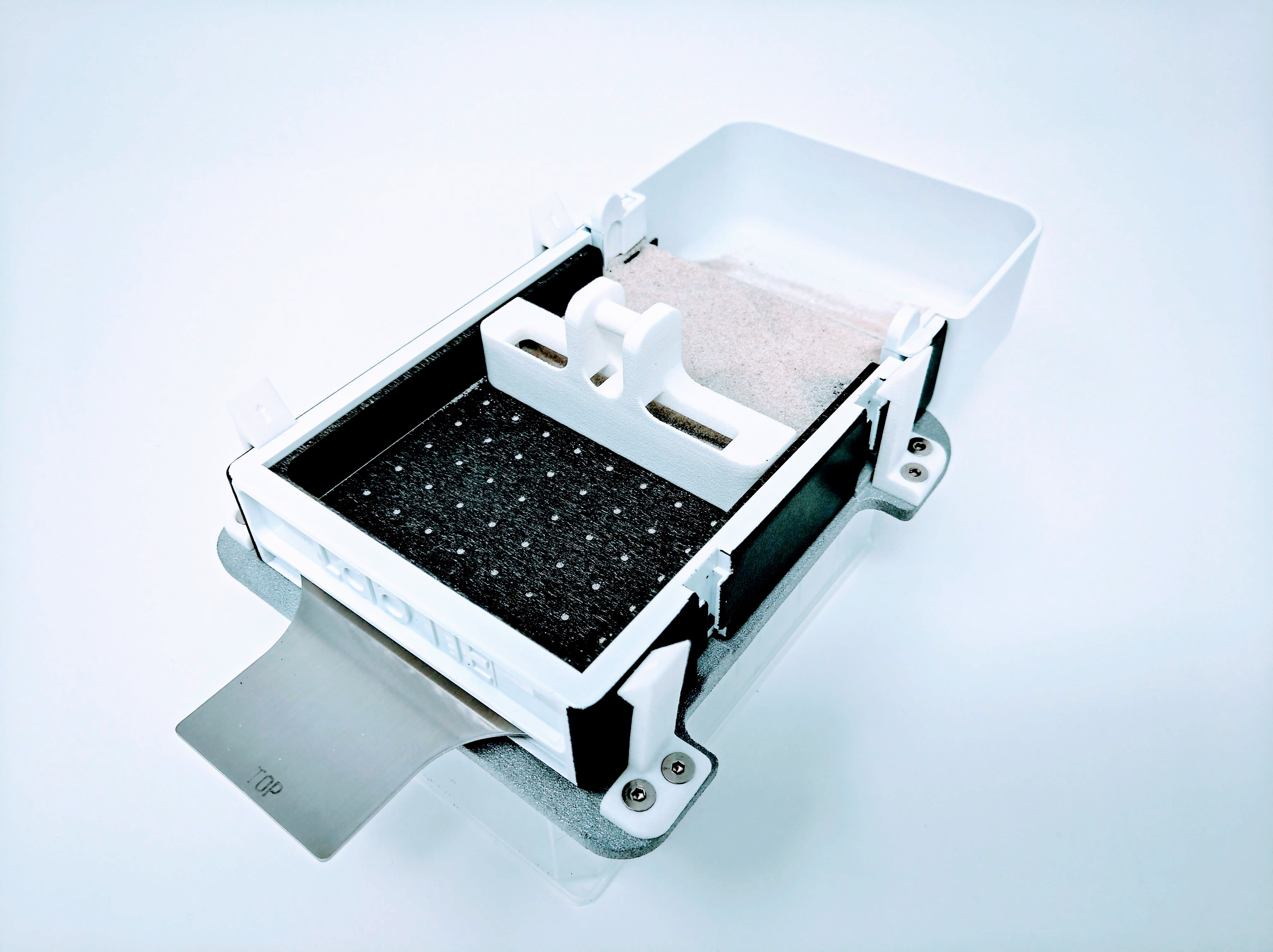
Filling a microplate with powder is one of those lab jobs nobody enjoys. Weighing a fixed amount into 96 or 384 tiny wells, one at a time, can swallow the best part of a morning. The manual powder dispenser that LabTIE builds in Doorn in the Netherlands does the same job in seconds, without software, calibration or a service contract.
At a glance. About 8 to 30 seconds to fill a plate. Under 1 percent dispensing error. One dispenser body fits 96 well, 384 well, tubes and vials.
The idea is simple enough that it is easy to underestimate. Instead of dosing each well on a balance, you charge a whole plate at once and let a mesh plate meter the amount. For a lab that fills hundreds of plates a week, that is the difference between a task and a bottleneck.
How it works
The dispenser is a flat block shaped like the plate it fills. You pour powder across the top, scrape the surface level with a card so every cavity holds the same volume, then pull a slider. The powder drops straight down, one equal dose into every well or tube at the same moment. Setting a different dose means swapping the mesh plate for one with different holes, so the same tool can fill a 384 well plate with a light powder in the morning and dose a coarser one into tubes in the afternoon.

Why weighing well by well slows a lab down
Dosing powder on a balance is accurate, but it does not scale. Every well is a separate weighing, a separate transfer and a separate chance for spillage. Move from a 96 well plate to a 384 well plate and the problem quadruples. Fine powders pick up static and scatter, open transfers drift between wells, and two technicians rarely produce identical plates. None of that shows up in the protocol, but all of it shows up in the data.
Filling the plate in one action removes most of those variables at once. The dose per well comes from the mesh plate rather than the operator, so replicates start out genuinely equal and the bench stays clean.
One tool, several formats
Most labs do not run a single labware format, so the dispenser is built around interchangeable plates rather than a fixed layout.
| Format | What it fills | How the dose is set |
|---|---|---|
| 96 well | Standard 96 well microplates | Swap the mesh plate |
| 384 well | High density 384 well microplates | Swap the mesh plate |
| 48 tube | Racks of 48 screw cap tubes | Swap the mesh plate |
| 45 tube | 45 position snap cap tube racks | Swap the mesh plate |
| Vials and custom | Small vials and non standard containers | Custom grid on request |

Where it is used
Powder dosing at plate scale turns up wherever a set amount of solid needs to reach a lot of wells quickly: pharmaceutical formulation and screening, analytical chemistry, diagnostics and materials research. LabTIE dispensers are used in labs at organisations including Bayer, Syngenta, Johnson & Johnson and Wageningen University, alongside many smaller groups running the same repetitive prep every day.
What it will not do
It is worth being clear about the limits. This is a manual tool, so it will not slot into a fully robotic line, and it is built to put the same dose in every well rather than a different weight in each. If your workflow needs a unique mass per well, a balance still wins. If it needs the same dose across a full plate, again and again, the dispenser is hard to beat on speed and price.
Try it on your own powder
The honest test is your own material and your own plates. If well by well weighing is the slow step in your prep, a manual powder dispenser is one of the cheapest ways to get that time back. Have a look at the formats above, or get in touch to talk through the powder and labware you work with.
Leave a Reply